Local elections were held in Poland on 7 April 2024 to elect members for all 16 regional assemblies (sejmik wojewódzki), 314 county (powiat) councils, and 2477 municipal (gmina) councils, heads (wójt) of municipalities and mayors of cities, as well as 18 district councils of Warsaw. While Law and Justice remained the strongest party, the Civic Coalition and its partners saw some improvement, providing them with majorities in up to 11 of the 16 regional assemblies. The second round to elect heads of municipalities, mayors and city presidents was held on 21 April in places where no candidate obtained more than 50% of votes.
Background
2018 Polish local elections
In the previous local elections held in autumn 2018, Law and Justice (PiS), Poland's ruling party at the time, won the most votes in the regional assembly elections, allowing it to take power in eight of the 16 voivodeships, mainly in eastern and southern Poland. The runner-up, the centrist-liberal Civic Coalition (KO), received 27% of the vote, which allowed it to maintain control over 8 voivodeships, together with its coalition partners: the agrarian Polish People's Party (PSL), the Democratic Left Alliance (SLD) and, in the Opole Voivodeship, the German Minority. Mayoral elections in large cities were won by KO candidates or opposition-backed independents, notably in Warsaw, where Rafał Trzaskowski defeated PiS candidate Patryk Jaki in the first round, winning 57% of the vote. Both PiS and the opposition claimed victory in the elections. As of March 2024, PiS controls 6 regional assemblies, while KO with its coalition partners holds 10.
Extension of the terms of office of local authorities
The current legislation in Poland, enacted in 2018, stipulates that the term of office of local authorities is five years from the date of election. As the previous election was held in the autumn of 2018, the next election would have to be held in the autumn of 2023, and would coincide with the election of the parliament, whose term of office was expiring in November of that year.
In September 2022, a new legislation was passed by the parliament, exceptionally extending the terms of office of local authorities until 30 April 2024. The lawmakers indicated that the extension of the term of office was necessary to avoid the organisational problems associated with holding local and parliamentary elections at approximately the same time. The regulation was criticized by the Association of Voivodeships, a voluntary association of regional governments, the Union of Polish Cities, the Helsinki Foundation for Human Rights, the National Council of Legal Advisers, as well as by experts of the Senate Legislation Bureau. Critics have pointed out, among other things, that the act may violate fundamental constitutional principles. They also questioned the legitimacy of concerns about the simultaneous organisation of local and parliamentary elections, and pointed out that the act does not address these problems systemically, only incidentally.
The act was signed into law by President Andrzej Duda on 22 November 2022.
2023 Polish parliamentary election
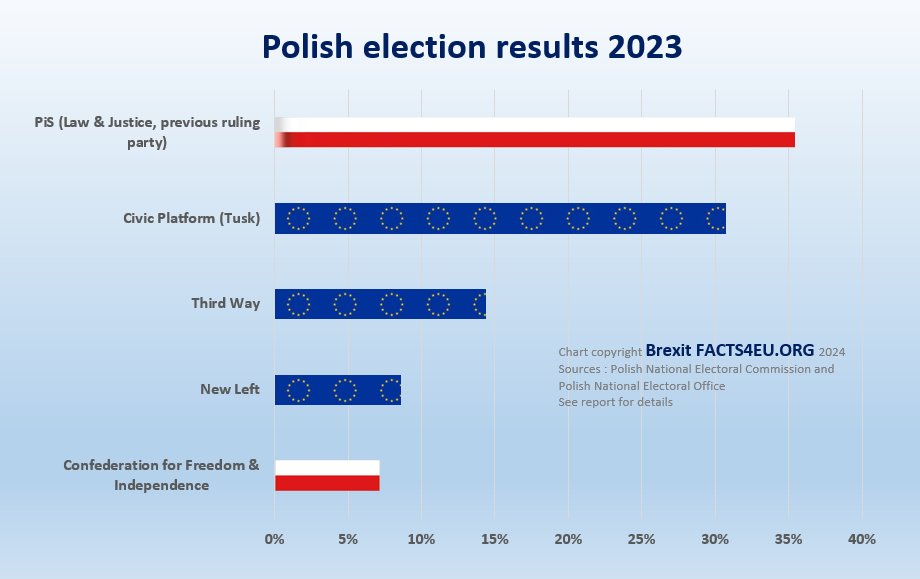
The parliamentary election held on 15 October 2023 saw the record turnout of over 74%. The ruling Law and Justice party received the highest number of votes, but lost its ability to form a majority government. Prime Minister Mateusz Morawiecki subsequently failed to form a coalition, and on 13 December a new government was formed under Donald Tusk, made up of the hitherto opposition parties: Civic Coalition, Poland 2050, Polish People's Party and the New Left.
Electoral system
The members of the voivodeship sejmiks, county councils, municipal councils for municipalities with more than 20,000 inhabitants, and Warsaw district councils are elected proportionally using the D'Hondt method. Each voivodeship, county, municipality, and district is divided into multiple constituencies. Each voivodeship sejmik constituency elects between 5 and 15 councilors, each county council constituency elects between 3 and 10 councilors, and each municipal council and Warsaw district constituency elects between 5 and 8 councilors. Parties or coalitions are required to receive 5% of valid votes throughout the entire voivodeship, county, municipality or district in order to be eligible to earn seats.
Municipalities with 20,000 inhabitants or fewer are divided into 15 constituencies, each of which elects 1 councilor using first-past-the-post.
Heads of municipalities, mayors, and city presidents are directly elected in each municipality using the two-round system.
Lists
National committees registered in all voivodeships
National committees registered in more than one voivodeship
National and local committees registered in a single voivodeship
Other national committees
Electoral committees
A total of 11,202 committees were registered for the elections. 41 committees applied for nationwide registration by the National Electoral Commission, of which 35 have been registered: 21 political parties, nine organizations, three coalitions and two voters committees. Four committees were rejected and one committee retracted its registration.
Campaigning
Prime Minister Donald Tusk said that a victory for the ruling Civic Coalition is necessary to prevent a return to nationalist rule by the Law and Justice Party, and portrayed its electoral campaign as a defense of "freedom, human rights, women's rights, democracy, free economy, self-government". Law and Justice denied such accusations throughout the campaign, with its leader Jarosław Kaczyński accusing the government of lying and calling the election an opportunity to present it with a "yellow card".
Opinion polls
Results
Exit polls showed that Law and Justice won 33.7% and the Civic Coalition won 31.9% in elections to the regional assemblies. The Third Way coalition was projected to win 13.5%, the Left 6.8% and the Confederation party 7.5%.
Results also showed that the mayor of Warsaw, Rafał Trzaskowski (Civic Coalition), won an outright victory in the first round, as did the mayor of Gdańsk, Aleksandra Dulkiewicz (Civic Coalition-supported independent). Winners were also proclaimed in the first round for mayoral races in Bydgoszcz (Rafał Bruski, Civic Coalition), Lublin (Krzysztof Żuk, Civic Coalition), Opole (Arkadiusz Wiśniewski, Civic Coalition-supported independent), Białystok (Tadeusz Truskolaski, Civic Coalition-supported independent), Katowice (Marcin Krupa, Civic Coalition-supported independent), Szczecin (Piotr Krzystek, Civic Coalition-supported independent), and Łódź (Hanna Zdanowska, Civic Coalition), while those in Wrocław, Toruń, Zielona Góra, Gorzów Wielkopolski, Kraków, Rzeszów. Olsztyn, Poznań and Kielce were to undergo a runoff. In the second round of elections held in 748 cities and towns on 21 April, the Civic Coalition won the mayoral elections in Kraków, Poznań, Wrocław, Rzeszów, Toruń, Zielona Góra and Legnica.
Voivodeship councils
Total
Election results (%)
Seats distribution
Powiat councils
Gmina councils
Mayors
Total elected mayors by alliance and party
Voivodeship capital mayoral and council elections
Bold – elected candidates
Warsaw
Warsaw Mayor
Warsaw City Council
Kraków
Kraków Mayor
Kraków City Council
Wrocław
Wrocław Mayor
Wrocław City Council
Łódź
Łódź Mayor
Łódź City Council
Poznań
Poznań Mayor
Poznań City Council
Gdańsk
Gdańsk Mayor
Gdańsk City Council
Szczecin
Szczecin Mayor
Szczecin City Council
Bydgoszcz
Bydgoszcz Mayor
Bydgoszcz City Council
Lublin
Lublin Mayor
Lublin City Council
Białystok
Białystok Mayor
Białystok City Council
Katowice
Katowice Mayor
Katowice City Council
Toruń
Toruń Mayor
Toruń City Council
Rzeszów
Rzeszów Mayor
Rzeszów City Council
Kielce
Kielce Mayor
Kielce City Council
Olsztyn
Olsztyn Mayor
Olsztyn City Council
Gorzów Wielkopolski
Gorzów Wielkopolski Mayor
Gorzów Wielkopolski City Council
Zielona Góra
Zielona Góra Mayor
Zielona Góra City Council
Opole
Opole Mayor
Opole City Council
Warsaw district councils
Reactions
Jarosław Kaczyński praised the election result, which he said highlighted the potential for greater success in the upcoming European election in June, and showed that reports of his political demise were "premature". Donald Tusk praised Rafał Trzaskowski on his reelection as mayor of Warsaw and called him the "hero" of the election night. He also acknowledged that conservative regions appeared to have mobilized more voters, while some of his party's supporters might not have voted due to fine weather conditions on 7 April. He also expressed happiness over the party's "record victory in cities" and its gains in the regional assemblies, while expressing concerns about "demobilization, especially among young people, failure in the east and in the countryside." Following the results of the runoff elections on 21 April, Tusk expressed satisfaction over the Civic Coalition's showing in key races and said that “Law and Justice has simply disappeared in many places”.
Notes
References


.jpg)